PDF(1468 KB)
 PDF(1468 KB)
PDF(1468 KB)
PDF(1468 KB)
大型体育赛事的成本与收益之争
The Controversy Over Costs and Benefits of Major Sporting Events
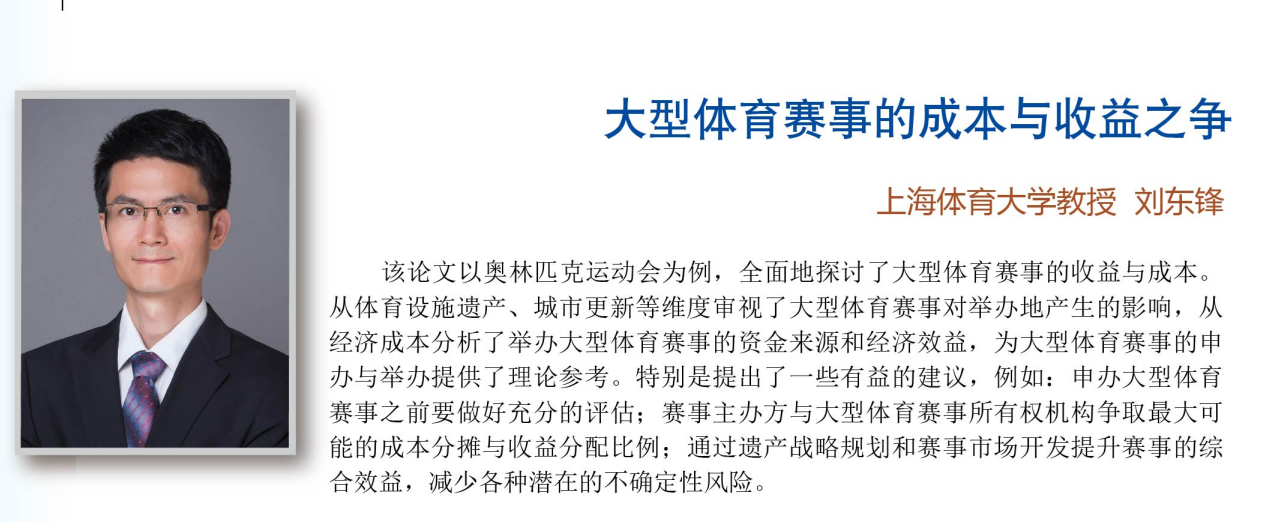
全面地认识大型体育赛事的收益与成本是提高办赛效益的前提。以奥林匹克运动会为例,运用文献研究法、案例分析法、逻辑分析法等方法分析大型体育赛事的成本与收益,并从体育设施遗产、城市更新等维度分析大型体育赛事对举办地产生的影响,为大型体育赛事的申办与举办提供理论参考。从经济成本分析,举办大型体育赛事需要财政资金投入,赛事的经济效益也并不一定显著。而在体育设施遗产、城市更新、主办地城市形象塑造、心理收入、体育发展等方面,同样是机遇与挑战并存。分析后提出,大型体育赛事申办之前应做好充分的评估,审慎选择赛事再作出是否申办的决定;主办方向赛事所有权机构争取赛事举办成本分摊与收益分配的最大可能的比例;通过遗产战略规划和赛事市场开发策略,提高赛事综合效益,减少各种潜在的不确定性风险。
A comprehensive and objective understanding of the potential benefits and possible costs of hosting large-scale events is a prerequisite for improving their effectiveness. Taking the Olympic Games as an example, this study employs methods such as literature review, comparative research, case studies, and logical analysis to deconstruct the cost composition and revenue sources of large-scale events in detail. It also examines the potential positive and negative impacts of such events on host locations from dimensions such as facility legacy and regional renewal, providing theoretical references for the bidding and hosting of major sports events. Results indicate that, from an economic perspective, hosting large-scale events generally requires subsidies from public funds, and their economic benefits are not significant. In terms of sports facility legacy, regional renewal, enhancement of the host's image, psychic income as well as sports development, opportunities and challenges coexist. It is suggested that scie.jpgic evaluation is essential for sports events selection and bidding decision; emphasis should be placed on costs and benefits sharing mechanism during the negotiation between host city and event owners; and strategic planning and active leverage is key to maximizing the benefits while reducing costs and risks of hosting major sporting events.
大型体育赛事 / 奥林匹克运动会 / 成本效益 / 经济影响 / 遗产
Major sporting events / Olympic Games / cost-effectiveness / economic impact / legacy
| [1] |
|
| [2] |
Many sports events, facilities, and franchises are subsidized either directly or indirectly by investments from public sector funds. The scarcity of tax dollars has led to growing public scrutiny of their allocation; in this environment there is likely to be an increased use of economic impact analysis to support public subsidy of these events. Many of these analyses report inaccurate results. In this paper, 11 major contributors to the inaccuracy are presented and discussed. They include the following: using sales instead of household income multipliers; misrepresenting employment multipliers; using incremental instead of normal multiplier coefficients; failing to accurately define the impacted-area; including local spectators; failing to exclude “time-switchers” and “casuals;” using “fudged” multiplier coefficients; claiming total instead of marginal economic benefits; confusing turnover and multiplier; omitting opportunity costs; and measuring only benefits while omitting costs.
|
| [3] |
In this paper, we explore the costs and benefits of hosting the Olympic Games. On the cost side, there are three major categories: general infrastructure such as transportation and housing to accommodate athletes and fans; specific sports infrastructure required for competition venues; and operational costs, including general administration as well as the opening and closing ceremony and security. Three major categories of benefits also exist: the short-run benefits of tourist spending during the Games; the long-run benefits or the “Olympic legacy” which might include improvements in infrastructure and increased trade, foreign investment, or tourism after the Games; and intangible benefits such as the “feel-good effect” or civic pride. Each of these costs and benefits will be addressed in turn, but the overwhelming conclusion is that in most cases the Olympics are a money-losing proposition for host cities; they result in positive net benefits only under very specific and unusual circumstances. Furthermore, the cost–benefit proposition is worse for cities in developing countries than for those in the industrialized world. In closing, we discuss why what looks like an increasingly poor investment decision on the part of cities still receives significant bidding interest and whether changes in the bidding process of the International Olympic Committee (IOC) will improve outcomes for potential hosts.
|
| [4] |
董杰, 霍建新. 近 4 届夏季奥运会财务状况的研究[J]. 体育与科学, 2007, 28(4): 28-35.
|
| [5] |
王永顺, 易剑东. 希腊债务危机是由雅典奥运会导致的吗?[J]. 体育与科学, 2012 (5): 7-10.
|
| [6] |
黄海燕, 张林. 体育赛事经济影响的机理[J]. 上海体育学院学报, 2009, 33(4): 5-8.
|
| [7] |
黄海燕. 体育赛事经济影响评价的实证研究[J]. 上海体育学院学报, 2011, 35(3): 1-6.
|
| [8] |
– The purpose of this paper is to examine the social impact of major sports events perceived by host city residents using Shanghai as an example.
|
| [9] |
|
| [10] |
张峰筠, 刘东锋, 吴殷, 等. 体育赛事举办地居民的体育赛事涉入度、心理收益与支持态度之间的关系研究——以“上海网球大师赛”为例[J]. 首都体育学院学报, 2021, 33(3):316-325.
|
| [11] |
In the context of the Sustainable Development Goals interest and concerns about the environmental impact of major sporting events have become increasingly widespread, voiced not only by organizers, but also spectators and residents of affected areas, as well politicians and institutional representatives of the host territories. There are multiple studies of the economic, social, and legal impacts of major sport events. Although several studies have pointed to a range of environmental impacts, there is no clear consensus on the effects that a major event can have on the natural environment. Thus, the aim of this article is to carry out a systematic review of the state of the art. Following the steps proposed by the PRISMA protocol, a selection of scientific articles from between 2000 and 2021 was made. The overall analysis shows that the negatives outweigh the positives, as only 32.91% of the effects described in the articles are deemed to be positive, with 62.03% deemed to be negative, and finally, 5.06% found to be inconclusive. With varying degrees of success, organizers and promoters of major events are already attempting measures to reduce negative impacts and enhance positive ones.
|
| [12] |
安俊英, 黄海燕, 陶倩. 体育赛事对举办城市环境影响评估研究[J]. 成都体育学院学报, 2013, 39(2): 31-35.
|
| [13] |
梁波, 张卫星, 李莉, 等. 大型体育赛事对城市生态环境的胁迫效应及应对策略研究[J]. 武汉体育学院学报, 2018, 52(5): 31-35.
|
| [14] |
|
| [15] |
贺凤凯, 王文龙, 张佑印. 体育参与涓滴效应:冬奥体育名人与大学生冰雪运动意愿的形成机制[J]. 首都体育学院学报, 2023, 35(3):326-335.
|
| [16] |
刘东锋. 大型体育赛事对主办国国家文化软实力影响的作用机制研究[J]. 首都体育学院学报, 2020, 32(3):207-213.
|
| [17] |
Although there is growing awareness of the relationship between hosting mega-sporting-events and destination image, there is little empirical evidence documenting what images people hold before an event. The purpose of this study was to investigate the images young Americans hold of China both as a tourist destination and as the host of the 2008 Olympic Games. Specifically, the relationships among destination image, travel intentions, and tourist characteristics were explored. A total of 350 college students were surveyed before the close of the Athens Olympic Games. Overall, the respondents perceived China and the Beijing Olympic Games positively. Destination image was significantly (p <.05) predictive of the intention to travel to China and the Olympic Games. Hierarchical regression analyses revealed that destination image partially mediated the relationship between past international travel experience and intention to travel. The theoretical and practical implications of these findings are discussed with a view to promoting China as a tourist destination and the host of the Olympic Games.
|
| [18] |
|
| [19] |
|
| [20] |
|
| [21] |
|
| [22] |
|
| [23] |
Olympics worth the price tag? The Montreal Legacy[Z/OL].(2012-06-19)[2025-06-06]. https://edition.cnn.com/2012/07/19/world/canada-montreal-olympic-legacy/index.html.
|
| [24] |
|
| [25] |
Los angeles 1984: n influential legacy[Z/OL].(2019-11-06)[2025-06-06]. https://www.olympics.com/ioc/news/los-angeles-1984-an-influential-legacy.
|
| [26] |
Rings of power: Peter ueberroth and the los angeles olympic games[Z/OL].(2004-03-06)[2025-06-06]. https://www.moaf.org/publications-collections/financial-history-.
|
| [27] |
Sponsor partnerships[Z/OL].(2019-03-06)[2025-06-06]. https://olympics.com/ioc/legacy/los-angeles-1984/sponsor-partnerships.
|
| [28] |
HOW L. A.'s 1984 summer olympics became the most successful games ever[Z/OL].(2014-02-06)[2025-06-06]. https://gizmodo.com/how-l-a-s-1984-summer-olympics-became-the-most-success-1516228102.
|
| [29] |
Olympic marketing fact file[Z/OL].(2024-02-06)[2025-06-06].https://stillmed.olympics.com/media/Documents/International-Olympic-Committee/IOC-Marketing-And-Broadcasting/IOC-Marketing-Fact-File.pdf?_ga=2.4966772.696364952.1673253504-553216475.1671706761.
|
| [30] |
IOC annual report 2016 credibility, sustainability and uouth[Z/OL].(2016-07-12)[2025-06-06].https://stillmed.olympics.com/media/Document%20Library/OlympicOrg/Documents/IOC-Annual-Report/IOC-Annual-Report-2016.pdf?_ga=2.149934142.945497859.1674092755-965461738.1674092755.
|
| [31] |
The IOC’s 2021 annual report[Z/OL].(2022-07-12)[2025-06-06]. https://www.olympics.com/ioc/news/the-ioc-s-2021-annual-report.
|
| [32] |
Tokyo 2020 organising committee publishes final balanced budget[Z/OL].(2022-06-21)[2025-06-06]. https://www.olympics.com/ioc/news/tokyo-2020-organising-committee-publishes-final-balanced-budget.
|
| [33] |
How are the olympic games financed?[Z/OL].(2024-06-06)[2025-06-06]. https://www.olympics.com/ioc/faq/olympic-marketing/how-are-the-olympic-games-financed.
|
| [34] |
Tokyo olympics say costs $12.6B: Audit report says much more[Z/OL].(2019-12-20)[2025-06-06]. https://apnews.com/article/eb6d9e318b4b95f7e53cd1b617dce123.
|
| [35] |
The london 2012 olympic games and paralympic games: Post-games review[Z/OL].(2012-12-05)[2025-06-06]. https://www.nao.org.uk/wp-content/uploads/2012/12/1213794fr.pdf.
|
| [36] |
Making the games: What government can learn from london 2012[Z/OL]. (2013-01-05)[2025-06-06]. https://www.instituteforgovernment.org.uk/sites/defa-ult/files/publications/Making%20the%20Games%20final_0.pdf.
|
| [37] |
|
| [38] |
Tokyo 2020 seen having $284 bn economic impact[Z/OL].(2017-07-03)[2025-06-06]. https://www.rfi.fr/en/contenu/20170307-tokyo-2020-seen-having-284-bn-economic-impact.
|
| [39] |
|
| [40] |
This article uses data from the 1996 Summer Olympic Games and the 2002 Olympic Winter Games to test the predictions of regional input-output models. Real changes associated with these events are insignificant. Nominal measures of demand overstate demand increases and factor price increases absorb the impact of real increases in demand. Nominal changes appear to be limited to hotel prices. Input-output models of a regional economy are often used to predict the impact of short-duration sporting events. Because I-O models assume constant factor prices and technical coefficients between sectors are calibrated from long-run steady-state relations in the regional economy, the predictions greatly overstate the true impact. Because the predictions of these models are increasingly used to justify public subsidies, understanding these deficiencies is crucial.
|
| [41] |
Third of london hotel rooms empty for olympics as 'normal' tourists stay away[Z/OL].(2012-06-05)[2026-01-15]. https://www.telegraph.co.uk/sport/olympics/news/9311869/Third-of-London-hotel-rooms-empty-for-Olympics-as-normal-tou-rists-stay-away.html?msockid=248fdc1daac0660b1eb9ca9aaba667f7.
|
| [42] |
Fact sheet-international olympic committee agenda 2020, the “New Norm”& the sustainability and affordability of hosting future olympic ¶lympic games[Z/OL].(2021-02-03)[2025-06-06]. https://content.olympics.com.au/public/2021-02/New%20Norm%20Fact%20Sheet.pdf.
|
| [43] |
“The New Norm”, an ambitious set of 118 reforms that reimagines how the olympic fames are delivered, was presented to the membership of the International olympic committee (IOC) at its 132nd session[Z/OL].(2020-07-03)[2025-06-06].https://www.olympics.com/ioc/new-norm.
|
| [44] |
|
| [45] |
Olympic agenda 2020:Olympic games: The new norm[Z/OL].(2018-02-03)[2025-06-06]. https://stillmed.olympic.org/media/Document%20Library/OlympicOrg/News/2018/02/2018-02-06-Olympic-Games-the-New-Norm-Report.pdf.
|
| [46] |
|
| [47] |
刘东锋. 城市营销中体育赛事与城市品牌联合战略研究[J]. 武汉体育学院学报, 2008, 42(5):38-41.
|
| [48] |
刘东锋. 冬奥会对国家形象与软实力的影响机制研究[J]. 体育学研究, 2019, 2(1):17-25.
|
| [49] |
|
| [50] |
|
| [51] |
The purpose of this paper is to develop a scale to measure the legacy of psychic income associated with the Olympic Games.
|
| [52] |
詹会会, 刘东锋, 刘钧昱. 大型体育赛事的“涓滴效应”:发生机制、现实困境与优化方略[J]. 上海体育学院学报, 2025, 49(11): 87-100.
|
| [53] |
|
| [54] |
Network approaches in sport management are mainly guided by the logic of sport products, where firms produce value that is used-up by consumers. This logic neglects the collaborative nature of sport. On the contrary, the logic of value co-creation provides a perspective where actors collaborate to co-create value in sport networks. Thus, this purely conceptual research aims to examine approaches to value co-creation in sport ecosystems to offer a holistic perspective on the interconnectedness of actors and engagement platforms. Using the concepts of value co-creation, engagement platforms, and sport network approaches, this paper conceptualizes the Sport Ecosystem Logic as a general theory to promote innovative research. Comprising five fundamental premises, the Sport Ecosystem Logic explains how actors’ shared interests in sporting activities evolve into an entire sport ecosystem. The Sport Ecosystem Logic advances our understanding of actors’ resource integration on sport engagement platforms and how these platforms are interconnected in a sport ecosystem.
|
| [55] |
刘东锋. 苏超”联赛的本质属性、内生逻辑及其对我国体育联赛发展的启示[J]. 体育学研究, 2025, 39(6):14-25.
|
| [56] |
ZIAKAS V. Planning and leveraging event portfolios: Towards a holistic theory[J]. Journal of Hospitality Marketing and Management, 2014, 23 (3): 327-356.
|
| [57] |
刘东锋. 中国特色体育赛事体系的内涵阐释、重构动因与实践方略[J]. 体育科学, 2025, 45(12):12-23.
|

/
| 〈 |
|
〉 |