
肌肉力量是指“人体神经-肌肉系统运动时克服或对抗阻力的能力”[1]。肌肉力量训练是运动处方的重要构成内容,维持一定的肌肉力量对保持身体形态、身体机能、预防非传染性慢性病等具有重要的作用。大量循证证据表明,有规律的抗阻训练可以有效改善机体代谢功能、增强神经肌肉兴奋性、提高体质健康水平、降低患病风险。肌肉力量的增长一方面来源于神经适应,另一方面来源于肌肉维度的增加,抗阻训练后产生的神经适应有助于肌纤维的募集,之后随着肌纤维增粗会进一步增大肌肉力量[2]。普通人群受锻炼时间、训练场地、训练设备、测试评估精准化等方面的影响难以高效增大和保持肌肉力量。多数人在健身房常用组合力量训练器材、自由重量器材,按照分割法进行抗阻训练,增大肌肉力量的效果相对较差[3]。还有相当一部分人受健美训练理念的影响,过分强调身体形态塑造,忽视肌肉力量训练在提高运动能力、增强身体机能等方面的重要作用。因此,探究精英运动员使用的科技手段和训练方法在普通人群中应用的实际效果,对广大民众科学健身具有重要意义。
近年来,国内脑科学研究开始赋能竞技运动训练科学化。其中,经颅直流电刺激( tDCS)是重要的无创神经启动技术,使用电极贴片将适当强度的直流电作用于大脑皮层,通过调控特定脑区兴奋水平、改善局部脑血流、增强不同脑区功能连通性等潜在作用机制,最终可以提高即时和长期力量训练效益[4]。与此同时,阳极经颅直流电刺激(a-tDCS)作为经颅直流电刺激的一种重要模式,通过将阳极电极置于目标脑区上方,可特异性增强该脑区的神经元兴奋性。有研究表明,阳极经颅直流电刺激可以调节大脑受刺激的区域的自发神经活动和大脑皮层的兴奋性,促进中枢神经系统募集更多的运动单位参与收缩,从而提高肌肉力量、爆发力、力量耐力等多种运动素质[5-7]。尽管有研究表明,阳极经颅直流电刺激结合抗阻训练可以有效增强运动员的肌肉力量和肌肉耐力,但是仍存在实验样本量较小、刺激方案标准不统一、个体差异较大等问题。因此,需要实验研究进一步验证及确认阳极经颅直流电刺激对健康成年人的力量训练效益的改善效果。
目前,国内多数使用经颅直流电刺激的相关研究都聚焦于探究阳极经颅直流电刺激对运动员运动表现的急性影响上,较少探究阳极经颅直流电刺激应用于普通人群对抗阻训练效益的影响及其科学机制。基于此,本研究以有一定抗阻训练经验的健康成年人为实验对象,通过为期5周的复合训练,探究阳极经颅直流电刺激结合抗阻训练对其下肢力量及无氧功率的促进效应。本研究的假设为:相对于单一抗阻训练,阳极经颅直流电刺激结合抗阻训练对健康成年人下肢力量和无氧功率的改善效果更好。
1 研究对象与研究方法
1.1 研究对象
受试者为有抗阻训练经验的健康成年人,使用G-power中的先验统计检验力分析,在重复测量方差分析模式下对样本量进行测算,选取效应量为0.3[8]、显著性水平为0.05、统计检验力(1-β)为0.8,得出至少需要24名受试者。最终,本实验招募30名有抗阻训练经验的受试者。所有受试者自愿参加实验,遵循训练计划和安排,未进行实验以外的下肢大强度力量训练,接受5周干预。受试者的纳入标准:1)年龄为18~25周岁;2)具有2年以上抗阻训练经验,每周至少进行3次抗阻训练;3)男性1RM深蹲超过其自身体重的1.2倍以上,女性超过自身体重的0.8倍以上;4)整个实验过程能保持良好作息,无饮酒或咖啡因摄入习惯。受试者排除标准:1)体内有金属植入;2)缺勤训练2次以上;3)存在癫痫等神经系统疾病或者其他影响实验的精神病;4)下肢关节急性损伤或慢性损伤;5)过去6周接受过侵入性治疗。所有受试者均知晓本实验的研究目的,了解实验流程和注意事项,自愿参与训练且签署了《知情同意书》,并顺利完成测试。受试者基本信息见表1。
表1 受试者基本信息 |
 |
1.2 实验设计
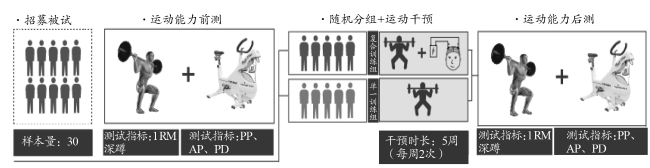
本研究采用单盲随机对照设计,将30名受试者随机分为复合训练组(阳极经颅直流电刺激+抗阻训练)和单一训练组(抗阻训练),每组15人,2组受试者的年龄、身高和体重无显著差异(p>0.05)。正式实验前一周带领受试者熟悉测试环境及测试流程,评估深蹲动作模式,并结合动作完成质量进行针对性的纠正训练,避免因深蹲动作不规范影响实验结果。正式实验测试分为3个阶段:第一阶段为基准值测试,使用自由力量深蹲架和功率自行车分别测试受试者的深蹲1RM和下肢无氧功率;第二阶段为干预训练,受试者接受持续5周(每周2次)的抗阻训练和阳极经颅直流电刺激干预,复合训练组接受阳极经颅直流电刺激结合抗阻训练,单一训练组仅接受抗阻训练;第三阶段为后测阶段,经过5周干预后,所有受试者再次接受1RM深蹲和下肢无氧功率测试。需要注意的是,为了减少无关因素对实验结果的影响,所有受试者在测试和干预训练期间都采用统一标准进行热身,并且在训练课中穿着运动装。此外,所有测试和训练都安排在上午进行,以控制生理节律导致的相关变化对研究结果的潜在影响,同时训练场地温度始终保持在22℃~25℃。实验流程如图1所示。
1.3 阳极经颅直流电刺激干预方案
1.4 抗阻训练方案
抗阻训练持续5周,每周训练2次,具体时间为每周一、周四的上午8点至11点。训练时,受试者先做一组8次空杠深蹲,再做一组8次60%1RM深蹲,以此作为热身,然后开始正式训练,深蹲负荷根据基线测试的1RM深蹲计算。正式抗阻训练方案如表2所示。
表2 抗阻训练基本内容 |
 |
1.5 测试指标
1)使用直接测量法测试下肢最大力量,要求双脚打开与肩同宽或略比肩宽,脚尖方向向前,膝关节的方向始终与脚尖的方向保持一致,下蹲时膝盖尽量不超过脚尖,蹲至大腿前侧与地面平行即可,然后逐渐增加负重直至受试者以正确动作完成一次蹲起,在测试过程中最好能在5次以内测出1RM深蹲的下肢力量,以免因疲劳而影响真实的下肢最大力量。
2)使用功率自行车测试受试者的无氧耐力,阻力设置(N)为阻力系数(0.75)乘以受试者体重(kg)。受试者在测试前进行4~8 min骑行热身,当心率达到150次/min时停止,并休息3~5 min。正式测试时,要求受试者在无负荷情况下尽全力蹬自行车,当踏板转速接近最快时,释放阻力篮全力蹬车30 s。在受试者蹬车过程中,提醒其应保持臀部与座椅接触,并在运动过程中对其不断进行口头鼓励,坚持运动直到30 s结束,测试结果由电脑自动采集和存储,测试指标包括由30 s温盖特试验得出的峰值功率(PP)、平均功率(AP)、功率衰减(PD)。
1.6 数据处理与分析
使用“SPSS 26.0”统计软件对实验数据进行统计与分析,所测数据以“平均值±标准差”(M±SD)表示。组间比较使用双因素重复测量方差分析自变量干预方式、测试阶段以及两者之间的交互效应对下肢肌力和无氧功率各指标的影响。组内比较以独立样本t检验分析各指标在实验前后的差异,显著性水平为0.05,效应量以Cohen's d 表示。效应量<0.19时为弱效应、效应量在0.20~0.49时为低效应、效应量在0.50~0.79时为中效应、效应量>0.8时为高效应。
2 研究结果
2.1 1RM深蹲测试结果
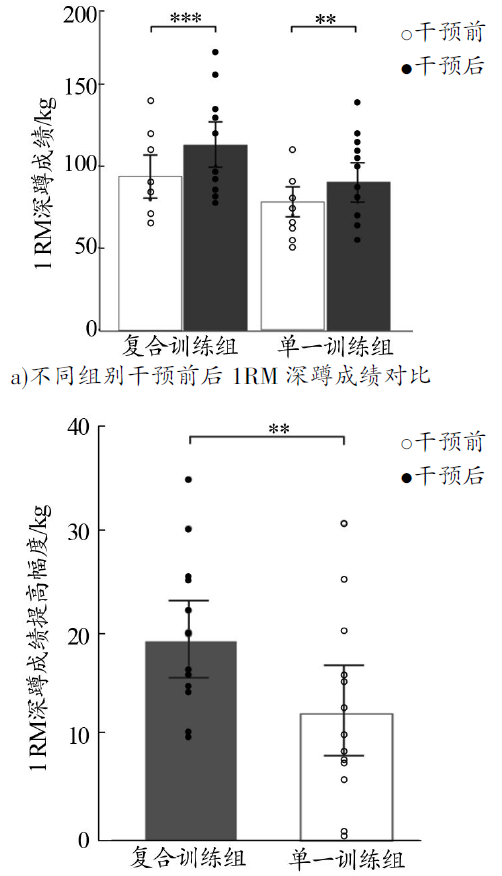
30名受试者全部完成实验,方差分析结果显示:1)测试阶段(干预前、干预后)的主效应显著〔F(1,28)=114.80, 偏η2=0.80,p<0.001〕,说明运动干预显著地提高了2组受试者的1RM深蹲成绩,如图3(a)所示;2)测试阶段和干预方式之间的交互效应显著〔F(1,28)=5.57,偏η2=0.17,p=0.03〕,说明运动干预后的改善效果受干预方式的影响,事后检验发现,复合训练组1RM深蹲成绩提高的效果显著于单一训练组〔复合训练组为(19.20±7.38)kg,单一训练组为(12.27±8.66)kg,t (28)=2.36,Cohen’s d=0.86,p=0.01〕,如图3(b)所示。
2.2 无氧功测试结果
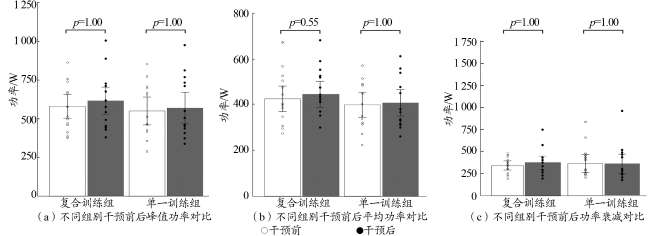
方差分析结果显示(如图4所示),峰值功率、平均功率和功率衰减3个指标干预前后的差异在复合训练组和单一训练组中均不显著(复合训练组:峰值功率数据为t (14)=1.19、Cohen’s d=0.21、p=1.00;平均功率数据为t (14)=1.75、Cohen’s d=0.17、p=0.55;功率衰减数据为t(14)=0.81、Cohen’s d=0.19、p=1.00;单一训练组:峰值功率数据为t(14)=0.62、Cohen’s d=0.11、p =1.00;平均功率数据为t(14)=0.80、Cohen’s d=0.08、p =1.00;功率衰减数据为t (14)=0.19、Cohen’s d=0.05、p=1.00)。
3 讨论
本研究主要目的是探究阳极经颅直流电刺激结合抗阻训练对健康成年人下肢肌力和无氧功率的影响。通过5周随机对照干预实验,对比阳极经颅直流电刺激结合抗阻训练和单一抗阻训练对下肢力量与无氧功率的改善效果,结果发现2种训练方案对1RM深蹲成绩的提高效果显著,且阳极经颅直流电刺激结合抗阻训练对1RM深蹲成绩的提高效果显著于单一抗阻训练,而2种训练方案对峰值功率、平均无氧功率和功率衰减的影响均不显著。
3.1 阳极经颅直流电刺激结合抗阻训练对下肢最大力量的影响
1RM深蹲可以体现个体下肢力量水平,在一定程度也可以反映身体健康水平,所以本实验以1RM深蹲作为评估下肢最大力量的指标。本研究发现,5周的阳极经颅直流电刺激结合抗阻训练相较单一抗阻训练可以更有效地增强受试者的下肢力量。有研究者发现,肌力在抗阻训练前期(2~4周)的增强主要与神经适应有关,随着训练的持续,肌力的增强则主要与肌肉维度增大有关[10]。本研究持续5周的实验结果显示,单一抗阻训练显著提高了1RM深蹲的成绩,由此可以推断是神经适应和肌肉维度发生变化后产生综合作用的结果。而当阳极经颅直流电刺激结合抗阻训练时,受试者1RM深蹲成绩的提高效果显著于单一抗阻训练组,说明通过阳极经颅直流电刺激产生了更好的神经适应。
首先,有一部分研究者以阳极经颅直流电刺激改善抗阻训练的效果。例如,有研究者发现,使用阳极经颅直流电刺激可以有效增强脑卒中患者下肢的肌肉力量[11] 。与之类似,还有研究者推断阳极经颅直流电刺激通过优化神经系统,可以提高脑卒中患者的神经肌肉控制能力[12]。此外,还有多项研究证实了阳极经颅直流电刺激结合抗阻训练可以增强健康成年人的肌肉力量。例如:Washabaugh等研究者对22名健康成年人进行的研究显示,阳极经颅直流电刺激结合伸膝训练可以有效提高下肢的伸膝力矩[13];Hendy等研究者对10名健康成年人施加阳极经颅直流电刺激结合单侧力量训练后发现,受试者肢体的肌力显著增强,神经激活水平显著提高,而单独的肌力训练或阳极经颅直流电刺激均未显著增强肌肉力量[14];Rodrigues等研究者将28名健康成年人随机分为阳极经颅直流电刺激结合抗阻训练组和假刺激结合抗阻训练组进行长期干预发现,阳极经颅直流电刺激结合抗阻训练相较假刺激结合抗阻训练可以更好地增强女性受试者伸膝肌力[15] 。尽管一部分研究已证实阳极经颅直流电刺激的积极效应,但是其中的潜在机制尚未完全阐明。传统观点认为,短期抗阻训练会引起皮质脊髓通路(即大脑-脊髓-肌肉的神经传导路径)的适应性改变,进而可以改善神经系统的适应性[16-18],而经颅直流电刺激还可能通过降低神经元膜电位阈值,增强其兴奋性,进而提高人体自主激活的程度,实现肌力的增强。如有研究表明,在抗阻训练结合经颅直流电刺激的条件下,受试运动员的自主激活(VA)提高了2%,同时还增强了最大力量[19]。此外,针对初级运动皮层(M1)的重复阳极经颅直流电刺激已被证明可以引发皮质兴奋性的长期变化,并且可以提高突触传递效率,产生长时程增强(LTP)效应[20-21] 。与此同时,还有研究者发现,受试者在使用阳极经颅直流电刺激后均表现出皮质静默期缩短的特征,这种变化反映了神经系统抑制控制的减弱,其潜在机制可能与γ-氨基丁酸-B型受体(GABA-B)介导的抑制性神经传递效率下降有关[22-24]。因此,阳极经颅直流电刺激结合抗阻训练使力量显著增强可能受益于中枢神经系统抑制效应下降,即通过降低运动神经元的激活阈值实现对肌肉纤维更充分和更高效的神经激活[22,24 -25]。总之,阳极经颅直流电刺激可以通过提高皮层兴奋水平增强人体自主激活程度,从而增加运动单元神经冲动频率和增强不同运动单元的放电同步性,而且阳极经颅直流电刺激结合抗阻训练还能进一步促进皮质脊髓兴奋,减少皮质内的抑制作用,从而产生更好的神经适应反应,进而显著增强下肢最大力量[17]。
其次,还有一部分研究者并未发现阳极经颅直流电刺激提高力量训练效益的证据。其潜在原因与阳极经颅直流电刺激脑区的选择、目标训练部位及受试人群有关。例如,Jung等研究者对55名健康成年人进行了6周的阳极经颅直流电刺激结合抗阻训练干预,结果显示阳极经颅直流电刺激结合抗阻训练组与假刺激组在下肢力量增强方面没有显著差异[26],这可能与该实验选择的刺激区域为非优势侧的M1区且无法对目标脑区产生有效的控制有关。与之类似,Maeda等研究者同样没有发现阳极经颅直流电刺激增强下肢最大力量的证据[27],但此研究的问题是,电极位置未覆盖可以影响下肢运动功能的相关脑区,这就可能导致神经调节靶点偏离,从而降低了干预的有效性。
3.2 阳极经颅直流电刺激结合抗阻训练对无氧功率的影响
在本研究中,复合训练组和单一训练组经过5周干预后的峰值功率、平均功率和功率衰减与训练前相比均没有显著变化。其中:峰值功率表示功率自行车骑行测试时达到的最大功率,体现的是受试者下肢在短时间内能产生的最大力量;平均功率指的是整个功率自行车骑行过程中输出的平均功率,体现的是受试者的耐力水平和持续输出力量的能力;功率衰减则体现的是人体在高强度运动时肌肉持续高功率输出和抗疲劳能力。这些指标受下肢神经肌肉、关节功能、无氧供能能力等多种因素的影响。本研究中的阳极经颅直流电刺激结合抗阻训练未能提高无氧功率,与抗阻训练方式和阳极经颅直流电刺激方案的设计有关。
3.2.1 峰值功率
峰值功率是力量和速度的乘积,是体现下肢爆发力的重要指标。需要注意的是,虽然肌肉横截面积在周期性抗阻训练后的增大有利于力量输出,但是如果训练计划缺乏高速度、快速伸缩复合等形式的爆发力练习,峰值功率也难以得到实质性提高。据此推断,本研究所采用的抗阻训练方案以大负荷深蹲训练为主,缺乏针对性的爆发力或快速力量转化训练,这可能是造成峰值功率在2种训练方案干预后没有提高的主要原因。有研究者同样发现,阳极经颅直流电刺激不会改善受试者的爆发力素质[30],而这其中的原因可能是,阳极经颅直流电刺激虽然可以使中枢神经系统更兴奋,但是要形成神经适应对爆发力的促进效应需要结合更有针对性的爆发力练习,而深蹲并非是适合发展爆发力的训练手段。此外,还有研究表明,以发展最大力量为主的大负荷抗阻训练还会对背蹲的峰值功率、峰值速度和峰值力量产生不利影响[31-33]。这说明抗阻训练的特异性对改善无氧功率测试成绩至关重要,抗阻训练的动作模式、动作速度、负荷选择等都是影响爆发力素质发生有益变化的重要因素。
3.2.2 平均功率
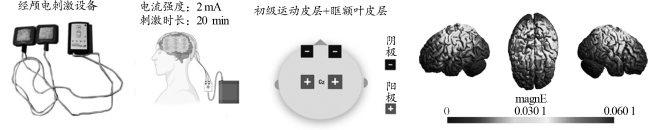
有相关研究与本研究的结果一致,该研究也没有发现阳极经颅直流电刺激结合抗阻训练可以提高受试者在温盖特试验中的峰值功率(PP)和平均功率(AP)[34]。此外,还有研究也表明,受试者在阳极经颅直流电刺激干预后的肌肉耐力水平没有发生显著变化[35]。同时,Machado等研究者的一项元分析结果显示,针对运动皮层的阳极经颅直流电刺激干预并没有改善上肢和下肢的等长肌肉耐力[36]。这表明经颅直流电刺激的刺激位置选择是导致一部分实验没有出现显著影响的重要原因。特别是在耐力研究中,不同脑区调控耐力时的机制存在显著差异,通过阳极经颅直流电刺激运动皮层对耐力任务表现的影响就有限。而前额叶皮层(PFC)与动机调节和抑制功能相关,对前额叶皮层脑区的阳极经颅直流电刺激则相较M1对耐力表现产生的促进作用更明显[37]。这一推断也得到一部分研究者的认同,如有研究者发现,使用经颅直流电刺激对前额叶皮层的干预可以通过改善中枢抑制和降低主观疲劳感增强受试者的肌肉耐力[38-39]。此外,刺激强度和时长的差异也会影响干预效果,虽然目前多数研究采用了2 mA、20 min的刺激方案,但是针对不同运动能力的特异性电刺激方案需要更多的研究进行探究,以便建立更为有效的神经调节方案。
3.2.3 疲劳指数
先前的研究证实了即时性的阳极经颅直流电刺激可以提高健康成年人肌肉抗疲劳的能力。例如,Cogiamanian等研究者对24名健康成年人使用阳极经颅直流电刺激进行干预,结果显示阳极经颅直流电刺激使神经肌肉疲劳下降15%,同时,左侧肘关节屈曲等长收缩达到力竭的时间显著延长[40]。与之类似,Abdelmoula 等研究者对11名健康成年人进行10 min阳极经颅直流电刺激后发现,肘关节35% 最大自主收缩(MVC)屈伸的力竭时间有所延长[41]。还有研究者推断,即时性的阳极经颅直流电刺激既可以通过增强运动皮质或皮质脊髓的兴奋性增加运动单位的募集数量和减少神经肌肉的抑制效应,还可以促进肌肉收缩过程中的运动感知觉整合,以及减少运动过程中的疼痛和疲劳感知,从而增强肌肉耐力[42]。但是也有研究表明,阳极经颅直流电刺激未能提高受试者的肌肉耐力水平。例如,Savoury等研究者发现阳极经颅直流电刺激未能增强受试者的下肢肌肉耐力[43]。有研究者推断其中的原因是,在最大功率输出状态下,所有快肌运动单位都已被充分募集,阳极经颅直流电刺激无法通过增强大脑皮层的兴奋性增加神经肌肉的额外募集[44]。综上所述,本研究中的5周阳极经颅直流电刺激结合抗阻训练并未显著影响峰值功率、平均功率、功率衰减的测试结果与抗阻训练方案和电刺激方案(如持续时间、电流强度、电极位置)的设计相关,说明训练方案和电刺激方案的参数设置会影响实际干预效果,针对提高不同运动能力的精准电刺激方案需要进一步进行深入研究。
3.3 局限性
首先,尽管本研究采用的抗阻训练方案对增强受试者下肢最大力量产生了效果,但是由于训练内容主要是高负荷、低次数的传统杠铃训练,未能系统地融入爆发力训练、以功率导向的练习以及无氧供能系统的训练,所以未能显著提高无氧功率。
其次,尽管阳极经颅直流电刺激在增强运动皮层兴奋性、提高神经肌肉控制能力等方面具有较多研究基础和潜在应用价值,但是本研究设定的刺激参数和靶区(即双侧M1区域)主要是依据下肢最大力量所需的神经调节机制设计的,未对与功率输出和疲劳感知密切相关的额叶前区(如背外侧前额叶皮层)进行刺激,这在一定程度上可能影响了其在促进无氧功率相关能力方面的干预效应,说明当前的神经调节手段在调控不同运动表现指标时应加强针对性。
最后,未来的研究可结合具体的训练目的,将阳极经颅直流电刺激与爆发力训练、耐力训练、复合式训练、同期训练、基于速度的力量训练等手段相结合,探索更具有针对性的电刺激综合调控方案,以满足广大民众的科学化训练需要。
4 结论
相较单一抗阻训练,阳极经颅直流电刺激结合抗阻训练对健康成年人下肢力量的增强效果更好。在全民健身战略实施背景下,神经调节技术与传统体能训练相结合具有良好的应用前景,对于训练时间和训练资源有限的健康成年人,建议将阳极经颅直流电刺激纳入健身训练计划中,将其作为增强下肢肌肉力量的一种辅助训练方法。