
近年来,我国体育产业在政策的大力支持、消费升级和科技创新的共同作用下,实现了跨越式增长。户外运动产业就是其中最活跃的一部分,体现出良好的发展前景。2022年发布的《户外运动产业发展规划(2022—2025年)》中提出了推动航空等重点户外运动项目差异化发展[1]。《中共中央关于制定国民经济和社会发展第十四个五年规划和二〇三五年远景目标的建议》中提出加快壮大航空航天产业。上述为航空运动的发展指明了方向。国家体育总局等部门于2016年联合发布的《航空运动产业发展规划》曾将滑翔伞列为发展项目,并提出支持长三角户外运动产业一体化发展,建设若干户外运动用品研发设计、生产制造、市场服务等全产业链的创新高地,发展滑翔伞等项目,辐射带动华东地区,打造华东户外运动示范区。与此同时,中国民用航空局在低空空域管理改革、“十四五”通用航空发展专项规划等相关文件中,持续推动简化飞行计划审批、低空空域管理改革,2024 年召开的全国两会首次将“低空经济”写入政府工作报告[2],2025年召开的第十四届全国人民代表大会第三次会议上的政府工作报告中又特别强调推动低空经济安全健康发展[3],这些不仅体现了我国政府对低空经济的高度重视,也标志着低空经济正式成为我国战略性新兴产业的重要组成部分,也为滑翔伞运动的安全化经营提供了制度保障。在多重政策支持下,滑翔伞运动以大众化、低参与门槛、高安全性等特点成为促进低空经济发展的重要运动项目。因此,在低空经济上升为战略性新兴产业、航空运动政策红利持续释放的背景下,深入探究滑翔伞运动基础设施与产业主体的地理空间布局,对优化航空运动产业地理空间布局、激发低空经济发展活力具有重要的现实意义。
滑翔伞是一种借助空气动力实现空中滑翔的运动项目,根据飞行理念的不同,滑翔伞可以分为休闲滑翔、竞技滑翔和特技滑翔。滑翔伞运动于1992年在我国正式开展[4]。随着航空运动在我国的逐步兴起,滑翔伞运动也逐步为大众所接受,从一项较少人涉足的高危险性运动项目发展为广受喜爱的、安全可控的新兴运动项目。目前关于滑翔伞的研究多数从物理学、材料学、运动医学、旅游管理等专业开展,涉及滑翔伞的气动技术原理[5]、制造材料[6-7]、运动损伤防治[8-10]、滑翔伞引领的休闲旅游产业发展[11-13]等方面。由于航空运动受地理因素的影响较大,不同的航空运动的场地布局和开展以及参与情况存在着明显的时空差异,对其时空规律的探讨有利于航空运动的空间布局调整、安全开展和高质量发展。近年来,不同类型的户外运动场地的地理空间分布特征已成为学界关注的重点,研究涉及滑雪场[14-15]、露营地[16]、马拉松赛事场地[17]、高尔夫球场[18]等,这些研究成果可以为航空运动的空间分布规律研究提供参考与借鉴。此外,滑翔伞运动属于新兴运动项目,低空经济属于新兴产业,当前对滑翔伞运动的发展规律研究仍较为欠缺。
基于以上,本研究以滑翔伞运动组织的空间分布特征为研究对象,使用空间分析的方法探究我国滑翔伞运动组织在数量上的空间分布特征及其影响因素,以期为滑翔伞运动高质量发展提供理论参考。
1 研究说明
1.1 分析对象的选取
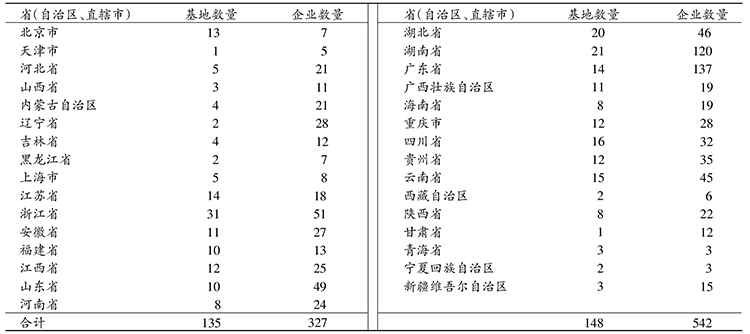
本研究主要以滑翔伞运动组织为分析对象,包括283个滑翔伞运动基地和869个滑翔伞运动企业,鉴于数据的可获取性,以上数据仅是中国31个省(自治区、直辖市)的(见表1),其中未统计台湾省的数据。
表1 滑翔伞运动组织数量统计结果 |
 |
1.2 数据来源
1)基础数据。①滑翔伞运动基地数据主要来源于地理信息系统以及科技零售企业交易平台(http://www.meituan.com),以“滑翔伞”“滑翔伞运动基地”“滑翔伞营地”为关键词进行筛选,得到有效数据283条。②滑翔伞运动企业数据主要来源于全国企业征信查询平台(https://www.qcc.com/),以关键词“滑翔伞”进行筛选,采集并整理该平台关于滑翔伞运动企业的信息,剔除经营范围无滑翔伞运动和地址不明确的企业,最终得到有效数据869条,涵盖了滑翔伞制造、滑翔伞销售、滑翔伞运动培训、滑翔伞赛事运营等不同的经营范围。
2)地理信息数据。①中国国界、省界、县行政区等地形图来源于国家基础地理信息中心地形图制图数据库。②全国数字地形图来源于地理空间数据云平台。③全国主要道路和主要铁路分布图来源于开放街道地图(OSM)。
3)统计数据。①实际GDP、常住人口数量、人均可支配收入的数据来自《中国统计年鉴》, 2023年年均风速和年均气温的数据来自《中国气象年鉴》。②31个省(自治区、直辖市)的低空经济政策信息来自《2025年低空经济产业与标准化发展报告》。
1.3 空间分析
$ f_{h}(\mathrm{x})=\frac{1}{n h} \sum_{i=1}^{n}\left(\frac{x-x_{i}}{h}\right)$
式中:fh(x)为核密度函数;x-x表示x到x的距离,h表示选定规则区域大于0的带宽,n为带宽h范围内滑翔伞运动组织的数量。fh(x)的值越大,说明滑翔伞运动组织在某一省(自治区、直辖市)的地理空间分布越密集,运用核密度分析法更能直观地反映滑翔伞运动组织的空间分布状况。
2)冷热点分析。冷热点分析是一种探究局部空间聚类规则的方法,用于确定研究对象在地理空间上的集聚区域(数值大为热点,数值小为冷点)。通常基于空间统计原理,通过计算每个空间单元与其邻域单元的属性值,将其与全局平均值进行比较,依此判断该单元是否属于热点或冷点[21]。
$ S=\frac{\sum_{i=1}^{n} y_{i}-50(n+1)}{100 n-50(n+1)}$
式中:S为不均衡指数;n为省(自治区、直辖市)的个数;yi为31个省(自治区、直辖市)的滑翔伞运动基地或企业总数占滑翔伞运动组织总数的比例由大到小排序后位列第i位的累计百分比。如果不均衡指数S=0,说明滑翔伞运动组织完全均衡分布;如果S=1,则说明滑翔伞运动组织完全不均衡分布;如果0<S<1,当S越趋近于0说明地理空间分布越均衡,越趋近于1说明地理空间分布越不均衡。
1.4 地理探测器
地理探测器是探测社会空间分异,以及揭示其背后驱动力的一种统计学方法,主要通过以q值表示自变量X对因变量Y的社会空间分异的影响程度,包含区域分异及因子探测、交互探测、危险区探测、生态探测四大模块,近年来被用于社会、经济、自然等问题的研究[24]。
$ q=1-\frac{1}{N \sigma^{2}} \sum_{h=1}^{1} N_{h} \sigma_{h}^{2}$
式中:q∈[0,1],q值越大说明自变量X对因变量Y的影响越大;h为因子X和变量Y的分层,即分类或分区;σ2h和σ2分别是层h和全区的单元数。如果q=0,说明自变量X与因变量Y完全无关;如果q=1,则说明自变量X完全影响因变量Y的地理空间分布。
2 滑翔伞运动组织的空间分布特征
2.1 地理空间分布特征
运用某软件绘制了中国滑翔伞运动组织的地理空间分布图。鉴于滑翔伞运动的经济属性和对地理条件的依赖,本研究选取了2套区域划分系统。其中:一套是按照“十一五”时期提出的东部、中部、西部、东北部划分为四大区域板块[25];另一套是根据中国地势高低的地理特征划分为三级阶梯。
1)东部、中部、西部、东北部区域差异。总体来看,滑翔伞运动组织的数量在我国东部、中部、西部、东北部地区呈现出显著的地域差异,具体是东部地区的滑翔伞运动组织呈现显著数量优势、西部和中部地区的滑翔伞运动组织的数量相对减少、东北部地区分布的滑翔伞运动组织数量较少(见表2)。由表2可知:东部地区的滑翔伞运动基地数量占各区域该类基地总数的比例为39.2%,滑翔伞运动企业数量占各区域该类企业总数的比例为37.7%,以上占比均为最多,且主要分布在江苏、浙江、广东等地;中部地区的滑翔伞运动企业数量占各区域该类企业总数的比例为29.1%,滑翔伞运动基地数量占各区域该类基地总数的比例为26.5%,中部地区的滑翔伞运动企业数量多于西部地区,滑翔伞运动基地数量却少于西部地区;西部地区的滑翔伞运动基地的数量为89个,虽然按照该类基地的区域分布数量由多到少排序位列第二,但是滑翔伞运动企业的数量却达到241个,尽管比中部地区分布的滑翔伞运动企业的数量少,但是却明显多于东北部地区,东北部地区无论是滑翔伞运动基地数量还是滑翔伞运动企业数量均较少,是滑翔伞运动发展的薄弱地区。
表2 滑翔伞运动组织的地理空间分布情况 |
 |
2)三级阶梯的差异。从三级阶梯分析可知,我国滑翔伞运动组织的空间分布与我国各地的地形地貌显著相关。具体而言:第三阶梯分布的滑翔伞运动组织的数量最多,地形主要是平原和丘陵(海拔500 m以下),主要分布在江苏、浙江、广东等省,这些地区凭借其发达的经济、大量的常住人口、完善的交通设施以及多样的消费需求,产生了大量的滑翔伞运动组织;第二阶梯分布的滑翔伞运动基地的数量相比第三阶梯多一些,大部分分布在重庆、四川、贵州、云南等地,这主要是由于第二阶梯是高原和盆地(海拔1 000~2 000 m),有足够的海拔高度,相比之下,滑翔伞运动企业在该区域主要呈现带状分布与点状分散分布的特征,主要集中在第二阶梯与第三阶梯分界线附近;第一阶梯分布的滑翔伞运动组织数量极少,主要是因为该地势阶梯的地形主要为平均海拔4 000 m以上的高原,不适宜大范围发展滑翔伞运动。
2.2 地理空间集聚特征
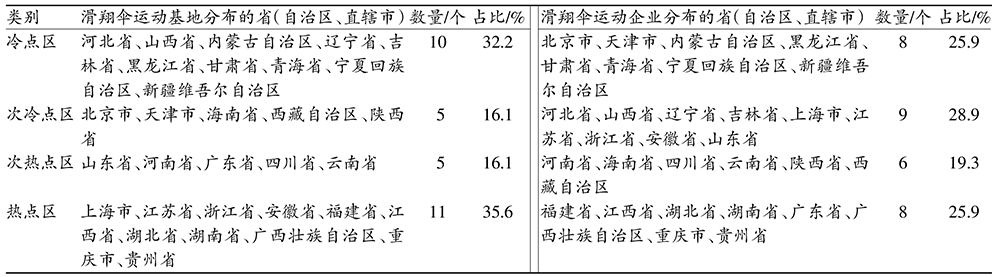
1)冷热点分析。从表3可知,滑翔伞运动组织的空间分布呈现出一致的地域分异规律,集聚区域可划分为4个等级。①冷点区主要分布于东北部、西北部、内蒙古自治区等地区。该区域气候复杂,且常住人口相对其他省份较少,滑翔伞运动有效需求不足,所以滑翔伞运动基地较少,滑翔伞运动企业的空间分布也较为稀疏,该区域是航空运动产业发展的薄弱地带。②次冷点区覆盖青藏高原及部分西南地区。受高海拔地形与交通可达性的制约,该区域的滑翔伞运动发展较为缓慢,但是独特的自然景观使其未来的特色化发展有了潜在可能。③次热点区分布于沿海地区部分省份与西南地区部分省份。沿海地区的航空运动需求持续增长,滑翔伞运动也有一定程度的发展,但是受专业人才与场地制约,目前在山东等部分地区还未形成集聚,而西南地区部分省份的海拔高度和气流条件使滑翔伞运动基地的建设具有了良好的地理条件,但是由于交通设施、经济发展等因素制约,相较于热点区,该区域的滑翔伞运动组织数量较少。④热点区分布于长江中上游及东南地区、华南地区、沿海地区部分省份。该区域经济发达、丘陵与山地地形多、政策支持力度大、体育市场活跃,这些特点共同促进了该区域的滑翔伞运动的发展,已成为我国滑翔伞运动发展的先行区。
表3 滑翔伞运动组织的地理空间分布的冷热点分析结果 |
 |
2)核密度分析。核密度分析结果显示,滑翔伞运动组织的空间分布呈现典型的中心-边缘结构,但是在集聚上存在显著差异,具体体现出以下4个特征。①滑翔伞运动组织在湘鄂地区和珠三角形成了高密度集聚。其中,湘鄂地区分别以咸宁(基地)和长沙(企业)为中心,珠三角则以广州和深圳为中心,在滑翔伞运动发展方面体现出综合优势。②滑翔伞运动基地在长三角形成了以杭州为中心的独立高密度集聚区。该区域凭借经济发达与成熟的户外运动市场形成了全国最密集的滑翔伞运动基地网络,但是滑翔伞运动企业在此区域不够集聚。③川渝地区是重要的次级高密度集聚区,滑翔伞运动组织在该区域呈现出以成都和重庆为双中心的分布规律,主要依托其独特地形与旅游资源发展“滑翔伞+”旅游业态。④京津冀、云贵高原等地区的滑翔伞运动基地的空间分布密度明显大于滑翔伞运动企业,呈现出滑翔伞运动企业与滑翔伞运动基地的不均衡分布特征。
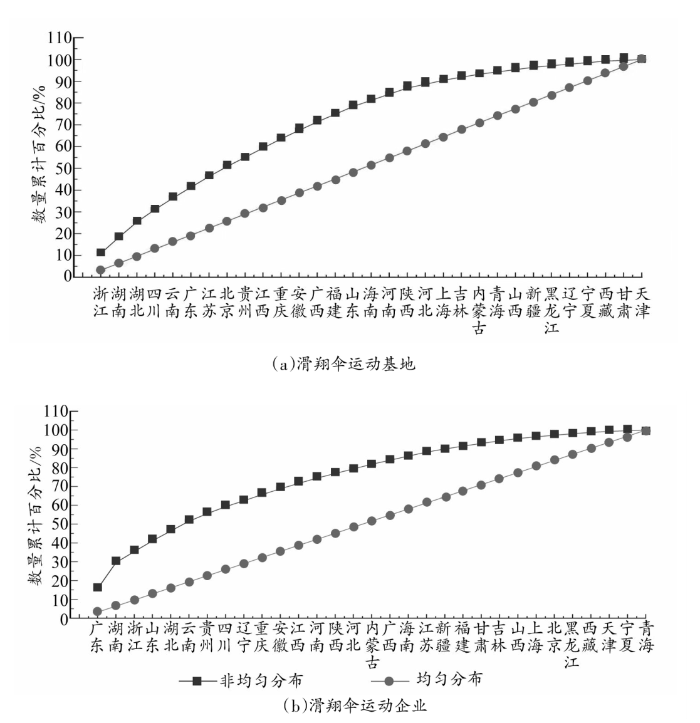
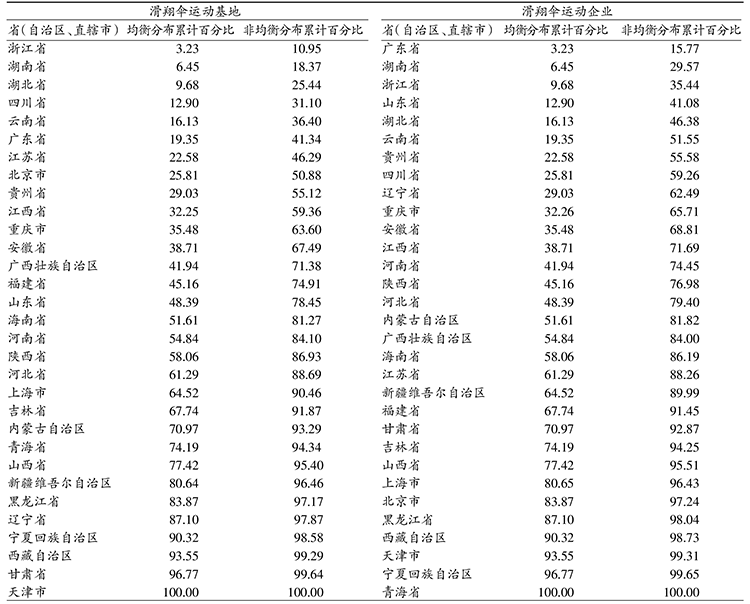
3)不均衡指数。运用不均衡指数对滑翔伞运动组织的空间分布均衡性进行评估,结果显示,滑翔伞运动基地与滑翔伞运动企业呈现出显著的空间不均衡分布规律(见图1和表4)。其一是整体不均衡特征显著。滑翔伞运动基地与滑翔伞运动企业的不均衡指数(S)分别为0.39与0.49,两者均小于1大于0,说明其整体的空间分布呈不均衡状态。其中,多数省份的滑翔伞运动企业的不均衡指数大于滑翔伞运动基地,说明多数省份的滑翔伞运动企业的空间分布比滑翔伞运动基地更为集中。其二是区域集中化现象凸显。洛伦兹曲线明显上凸,进一步验证了滑翔伞运动组织在数量上的地理空间分布的区域高度集中性。具体而言:浙江省、湖南省、湖北省、四川省的滑翔伞运动基地总数占全部统计地区滑翔伞运动基地总数的32%;而广东省和湖南省的滑翔伞运动企业总数占全部统计区域滑翔伞运动企业总数的30%,说明滑翔伞运动企业在这2个省高度集聚。
3 滑翔伞运动组织在数量上的空间分布影响因素
3.1 影响因素的选取
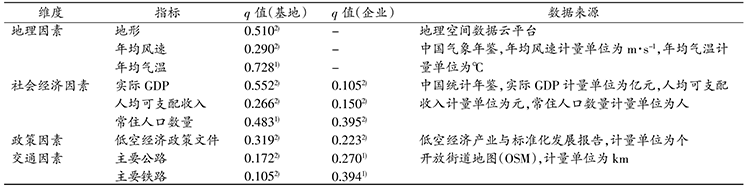
表5 滑翔伞运动组织的空间分布特征影响因素 |
 |
注:1)、2)分别表示在1%和5%的水平上显著。 |
由表5可知,各个影响因素对滑翔伞运动基地与滑翔伞运动企业的影响程度各不相同。从对滑翔伞运动基地的影响来看,q值由大到小排序为年均气温、实际GDP、地形、常住人口数量、低空经济政策文件、年均风速、人均可支配收入、主要公路、主要铁路。从对滑翔伞运动企业的影响来看,地理因素的影响不显著,其他因素的q值由大到小排序依次为常住人口数量、主要铁路、主要公路、低空经济政策文件、人均可支配收入、实际GDP。由此可见,滑翔伞运动基地的分布受地理因素、社会经济因素、政策因素、交通因素的共同影响,而滑翔伞运动企业则主要受社会经济因素、政策因素和交通因素的影响。在此需要特别说明的是,滑翔伞运动涉空高度为地面垂直向上的100~4 000 m,民航空域管制高度一般为地面垂直向上的16 000 m以上,关于滑翔伞运动在空域管制范围的相关数据难以获取,所以本研究未分析空域管理因素。
3.2 影响因素分析
3.2.1 地理因素是影响滑翔伞运动基地空间分布的主要指标,但是对滑翔伞运动企业的空间分布影响不显著
1)年均气温是气候的表现,滑翔伞运动因受气温制约所以发展存在地域差异。表5显示,滑翔伞运动组织的空间分布区域的年均气温的q值达到0.7以上,且在1%的水平上显著,说明年均气温对滑翔伞运动的影响非常显著。在实际参与滑翔伞运动时,也对气温要求较高,最适宜飞行的气温为10~30℃,在此气温区间内,上升气流活跃且较稳定。年均气温在15℃以上的地区适宜进行滑翔伞运动,如上海、江苏、浙江、湖北、湖南、广东等地具有滑翔伞运动年适飞期长、气流相对恒定的理想条件,所以有37%的滑翔伞运动基地集中于此,成为滑翔伞运动基地集聚发展的区域。而我国西部(西藏自治区、青海省、新疆维吾尔自治区)及东北部(辽宁省、吉林省、黑龙江省)的某些地区的年均气温在0℃以下,因冬季气温低、结冰风险大以及适飞期短,不利于进行滑翔伞运动,所以这些地区的滑翔伞运动基地的数量在全部统计区域的该类基地总数中的占比不足10%,说明这些地区的滑翔伞运动发展明显滞后。
2)地形高差是影响滑翔伞运动的直接因素。滑翔伞作为一种依靠重力和气流相互作用的航空运动,对地形条件的要求较高,地形高差和区域小气候是滑翔伞场地建设的主要制约因素,直接影响滑翔伞飞行条件、运动安全和滑翔伞运动基地选址。地理探测器分析结果显示,当影响滑翔伞运动基地的空间分布的地形要素q值达到0.5以上,且在5%的水平上显著,便是滑翔伞运动基地选址的关键因素之一。在滑翔伞运动基地选址过程中,起飞场通常要具备山体高差适宜、场地平坦、视野开阔且容易到达的条件,而降落场则要选择平坦、无障碍物的开阔区域。目前,滑翔伞运动基地的飞行空域海拔在100~4 000 m之间。其中的湖北省、湖南省等地的丘陵山区海拔大多在500~1 500 m之间,既能确保足够的起飞高度,又能确保安全降落以及满足训练与体验的需求,这些地区聚集的滑翔伞运动基地占全部统计区域的该类基地总数的14.5%;江苏省、浙江省、广东省等地虽然海拔大多在200 m以下,且天然地形高差不足,但是凭借其经济发达和巨大的体育消费市场,依靠建设人工坡地、动力牵引等手段辅助起飞,已形成以滑翔伞运动初级教学和休闲体验为主的业态,分布于此的滑翔伞运动基地在全部统计区域该类基地总数中占比为20.8%;西藏自治区、青海省等平均海拔超过4 000 m的地区则因海拔高而导致气流不稳,所以这些地区的滑翔伞运动基地数量合计占比不足全部统计区域分布的该类基地总数的2%,且地理空间分布较为稀疏。
3)风为滑翔伞提供动力,风速直接影响滑翔伞飞行速度和运动安全。滑翔伞运动基地的选址不仅要考虑地形高差,而且要考虑风速对滑翔伞运动基地的选址以及滑翔伞飞行安全的影响。相关研究显示,最适宜滑翔伞安全飞行的风速不应超过5 m/s[4],而我国不同地区的风速有显著差异,所以滑翔伞运动基地在数量上的地理空间分布也有明显的差异。例如:北京市、河北省、安徽省、河南省、重庆市、四川省、贵州省等地属于气流恒定地区,常年风速适宜,能够提供恒定的动力气流和上升气流,有利于滑翔伞的起飞和长时间飞行,分布于此的滑翔伞运动基地在全部统计区域该类基地总数中占比达到27.2%;浙江省、山东省、广东省、云南省等地的风速也相对恒定,所以分布于此的滑翔伞运动基地数量占全部统计区域该类基地总数的比例也达到24.7%;而内蒙古自治区、西藏自治区、新疆维吾尔自治区等地常年有大风或阵风频繁,不利于长时间从事滑翔伞运动,所以这些地区的滑翔伞运动基地数量仅占全部统计区域该类基地总数的2.5%。
3.2.2 交通因素:主要公路主导滑翔伞运动基地的空间分布,主要铁路带动滑翔伞运动企业的空间集聚
1)主要公路对滑翔伞运动基地的影响大于主要铁路。公路网决定了滑翔伞运动基地的交通可达性,滑翔伞运动基地的分布与其高度耦合,占滑翔伞运动组织总数85%的滑翔伞运动基地位于主要公路附近2 h交通可达范围内,形成了明显的沿公共交通线路网分布的特征。具体而言,在公共交通线路网密集的长三角、珠三角、京津冀地区,滑翔伞运动基地分布最为集中,占全部统计区域分布的该类基地总数的34.9%;但是在我国中部地区,滑翔伞运动基地则主要沿着穿越山区的国道与省道分布,此区域的滑翔伞运动基地数量占全部统计区域该类基地总数的26.5%。相较而言,主要铁路对滑翔伞运动基地的空间分布的直接影响有限(q=0.104),其作用更多体现为,通过增强区域整体交通可达性间接影响滑翔伞运动基地的旅游客源市场。
2)主要铁路对滑翔伞运动企业的空间分布的影响略大于主要公路。滑翔伞运动企业的空间分布对主要铁路体现出更强的依赖性,而主要公路决定着滑翔伞运动企业的空间分布范围。在公共交通线路网密集的东部地区与中部地区,滑翔伞运动企业的数量分别占全部统计区域该类企业总数的37.7%和29.1%,但是主要铁路对滑翔伞运动企业的空间分布具有系统性的重塑作用(q=0.394)。其中,高铁路网极大地拓展了滑翔伞运动企业的市场腹地,使其能满足更多人的滑翔伞运动参与需求。例如,在珠三角、长三角、华中交通枢纽城市等高铁路网密集的区域,这些区域分布的滑翔伞运动企业总数占比超过全部统计区域该类企业总数的50%,说明主要铁路对滑翔伞运动企业产生了较大的影响。
3.2.3 实际GDP与常住人口数量对滑翔伞运动基地的空间分布影响最显著,常住人口数量和人均可支配收入对滑翔伞运动企业的空间分布影响最显著
1)实际GDP对滑翔伞运动基地的空间分布影响最显著,而常住人口数量对滑翔伞运动企业的空间分布影响最显著。对滑翔伞运动基地空间分布影响最大的社会经济因素是实际GDP(q=0.551),如江苏、浙江、广东3个经济大省形成了全国最密集的滑翔伞运动基地网络,这3个省的滑翔伞运动基地总数占全部统计区域该类基地总数的21.9%,浙江省的滑翔伞运动基地总数在其中的占比达到11.5%。而对滑翔伞运动企业的空间分布影响最显著的则是常住人口数量(q=0.394),作为人口大省的广东和山东分布的滑翔伞运动企业在全部统计区域该类企业总数中的占比分别为15.8% 和5.63%,充分验证了胡焕庸线区位效应中的旅游市场潜力效应[31]。
2)常住人口数量对滑翔伞运动基地的空间分布影响较显著,而人均可支配收入对滑翔伞运动企业的空间分布影响较显著。对滑翔伞运动基地的空间分布影响较显著的社会经济因素是常住人口数量(q=0.483)。例如,湖北省和湖南省虽然不居于全国人口大省前列,但常住人口数量并不少,所以该区域分布的滑翔伞运动基地较为密集,2个省分布的滑翔伞运动基地占全部统计区域该类基地总数的14.5%。而对滑翔伞运动企业的空间分布影响较显著的则是人均可支配收入(q=0.150)。例如,北京、上海等地在本研究期的人均可支配收入均超过80 000元,滑翔伞运动企业在这些地区分布的数量也较多,占全部统计区域该类企业总数的17.2%。
3)人均可支配收入对滑翔伞运动基地的空间分布影响最小,实际GDP对滑翔伞运动企业的空间分布影响最小。地理探测器的分析结果表明,对滑翔伞运动基地的空间分布影响最小的社会经济因素是人均可支配收入(q=0.266)。尽管北京、天津、上海等地在本研究期的人均可支配收入都超过50 000元,但是由于平原地形多,适宜发展滑翔伞运动的区域少,所以北京市分布的滑翔伞运动基地仅占全部统计区域该类基地总数的6.7%。而对滑翔伞运动企业的空间分布影响最小的是实际GDP(q=0.105)。例如,江苏、河南、福建的实际GDP在本研究期都超过5万亿元,但是分布的滑翔伞运动企业的数量却仅占全部统计区域该类企业总数的6.3%。
3.2.4 相关政策对滑翔伞运动基地空间分布的影响较显著
地理探测器的分析结果显示,低空经济相关政策对滑翔伞运动基地(q=0.319)与滑翔伞运动企业(q=0.223)的空间分布的影响均在2%的水平上显著,表明相关政策是滑翔伞运动组织的空间分布的重要影响因素,并且对滑翔伞运动基地的空间分布的影响显著于滑翔伞运动企业。
1)相关政策对滑翔伞运动基地建设起着引导作用。低空经济相关政策对滑翔伞运动基地的空间分布的影响显著(q=0.319),主要体现为在低空空域开放、飞行营地规划、基础设施建设等方面产生了推动作用。从本研究来看,低空经济相关政策直接引导了滑翔伞运动基地的选址与建设,特别是鼓励低空经济发展政策的出台,促进了滑翔伞运动基地的空间集聚。例如,在江苏(14个)和浙江(31个)分布的滑翔伞运动基地数量居于31个省(自治区、直辖市)的前列,这2个省分布的滑翔伞运动基地总数占全部统计区域该类基地总数的15.8%,形成了较为密集的滑翔伞运动基地网络。
2)相关政策对滑翔伞运动企业空间分布的影响较为间接。目前,有关滑翔伞运动的政策更侧重于低空空域开放、体旅融合等市场前端,对滑翔伞运动企业空间分布的影响相较滑翔伞运动基地小(q=0.223),但其在培育体育产业生态系统、引导滑翔伞运动企业集聚方面产生的作用不容忽视。尽管滑翔伞运动企业的空间分布受需求、投资环境、经济发展、人才资源等多种因素的影响,但是各地政府通过产业升级政策、规范市场秩序、优化营商环境也对滑翔伞运动企业的空间分布产生了影响。例如,河南、广东、四川等地分布的滑翔伞运动企业总数占全部统计区域该类企业总数的22.2%。
4 结论
1)从体育地理学视角分析发现,滑翔伞运动组织在数量上呈现出显著的地域差异,主要特征是:我国东部地区的滑翔伞运动组织呈现出显著的数量优势;我国西部地区和中部地区分布的滑翔伞运动组织的数量相对减少;我国东北部地区分布的滑翔伞运动组织数量较少。
2)从三级阶梯来看,中国滑翔伞运动组织在数量上呈现出明显的地域差异。具体是:第三阶梯分布的滑翔伞运动组织的数量最多,主要分布在江苏、浙江、广东等地,这些地区凭借经济发达、常住人口数量多、完善的交通设施以及多样的体育消费需求,产生了大量的滑翔伞运动企业;第二阶梯分布的滑翔伞运动基地的数量相对较多,因为第二阶梯主要是高原和盆地,使从事滑翔伞运动具有足够的海拔高度;第一阶梯分布的滑翔伞运动组织的数量较少,因为该地势阶梯的地形主要是平均海拔为4 000 m以上的高原,所以适宜发展滑翔伞运动的区域少。
3)滑翔伞运动组织形成了空间集聚区域,主要包括湘鄂地区和珠三角形成的高密度集聚区、长三角形成的以杭州为中心的滑翔伞运动基地独立高密度集聚区,但是滑翔伞运动企业在此区域不够集聚。滑翔伞运动基地与滑翔伞运动企业呈现出空间不均衡分布规律,即多数省份的滑翔伞运动企业在数量上的地理空间分布比滑翔伞运动基地更为集中。其中:浙江省、湖南省、湖北省、四川省分布的滑翔伞运动基地总数占全部统计区域的该类基地总数的32%;广东省和湖南省分布的滑翔伞运动企业总数占比将近全部统计区域该类企业总数的30%。
4)滑翔伞运动基地的空间分布受地理、交通、社会经济、政策4个维度因素的共同影响,地形、年均气温、实际GDP、常住人口数量4个因素对滑翔伞运动基地空间分布的影响较显著。而滑翔伞运动企业的空间分布受社会经济、政策和交通3个维度6个因素的共同影响,其中常住人口数量、主要铁路和主要公路3个因素对滑翔伞运动企业空间分布的影响较显著。